
The iliotibial band, or ITB, runs along the other edge of the thigh and into the knee. It’s often blamed for pain in the area, especially among runners. People may advise that the band is likely “tight” and should be stretched or foam rolled. But it’s not a muscle, so treating it like one might not be the best approach. We should question if it has a good reason to be “tight” in the first place, if indeed it is. Could it actually be reacting to protect something?
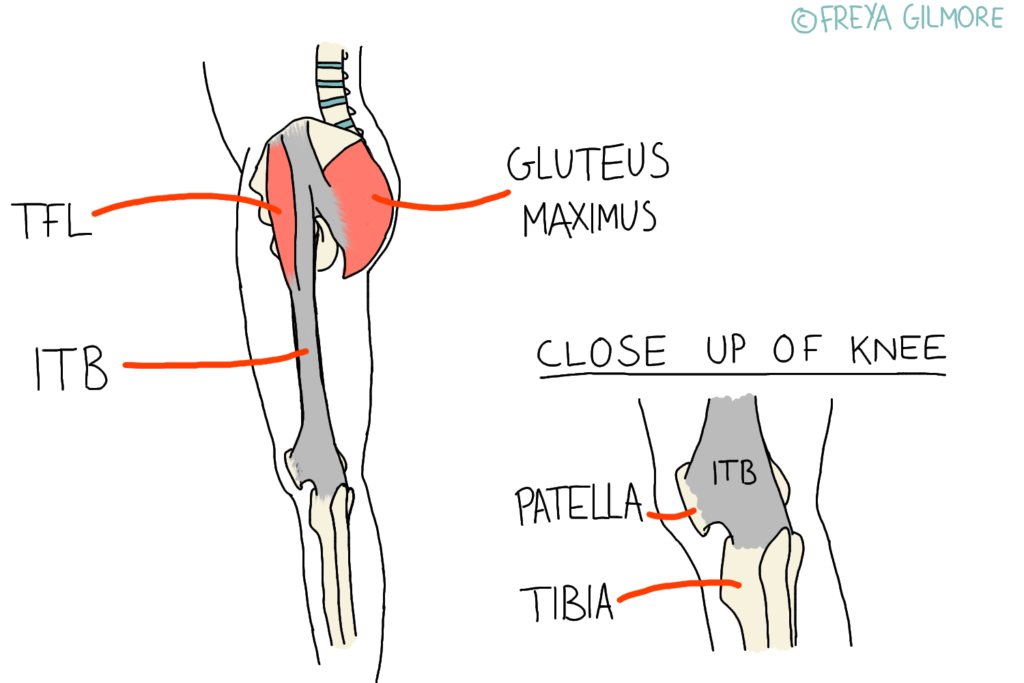
What Is the IT Band?
The IT band is a thick band of connective tissue, running along the outside of the thigh. It blends from a muscle that attaches to the pelvis, all the way down to the knee, where it connects to the knee in a few different places. Because of its positioning, it can influence (and be influenced by) both the hip and the knee. So symptoms can be somewhat nebulous and hard to pin down.
Since it’s made of non-contractile tissue, in contrast to the muscle it blends from, it cannot contract or relax itself. So in fact, a tight ITB is not an isolated thing: it comes back to a tight TFL. The TFL is the tensor fascia lata: the muscle at the top of the ITB. This is what’s responsible for controlling the tension in the ITB, and would be the responsive area to treat if you did want to relax the band. Massaging or rolling the band can be uncomfortable and ineffective.
But first bear in mind the role of ITB. Form follows function, and this tissue is made for support and stability. If TFL wants it tighter, thus more supportive, we have to wonder why. It’s possible that it’s a problem with the TFL, such as a change in activity that’s causing tension around the hip, or it might be that the TFL wants to protect the knee.
The ITB and Knee Stability
The IT band plays an important role in stabilising the knee. The knee itself is a somewhat vulnerable joint, as it’s mostly just a hinge that takes the entire bodyweight while we move around on two legs. Running and jumping ask a lot of this joint complex, even things like climbing up or down stairs are demanding for a relatively unstable joint. ITB helps to stabilise the knee by limiting lateral movement.
If there is a problem with knee stability, such as a ligament sprain, the ITB can be used to support further. Increasing tension, thus limiting side-to-side movement further, may help to prevent further injury and allow the damaged tissues to heal. If this is the case, it’s best not to try and bring tension down to the baseline. It’s there for good reason and although it might be uncomfortable, it might be preventing future discomfort.
Osteopathy for ITB Symptoms
Osteopaths assess how the hip, knee, and pelvis, and beyond are working together. After reviewing the symptomatic area, we look for patterns that might suggest involvement of other areas. With this holistic view, we can then develop a management plan that aims to resolve current symptoms while also preventing further compensatory injuries elsewhere. Treatment is tailored to you, but may involve working with the TFL, improving joint movement, and prescribing exercises that restore stability and control. If associated with your current exercise routine, we can also offer advice on changes to make there.
If you’re struggling with ongoing pain along the outside of the knee or thigh, make an appointment with one of our osteopaths below.
Book an appointment for your ITB pain in Pewsey or Devizes here

