
Perthes disease is a rare condition that affects the thigh bone of young children. Some cases are associated with early osteoarthritis later on.
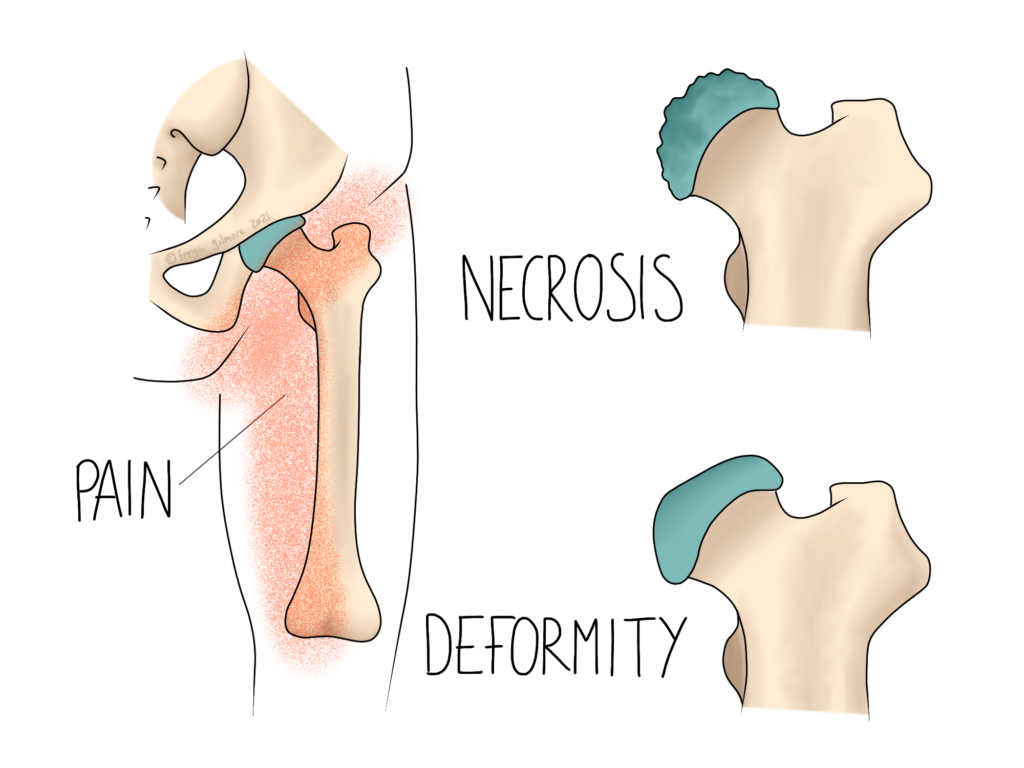
Symptoms of Perthes’ Disease
A child may complain of hip or groin pain, spreading into the areas shown in the diagram above. They may also develop a limp and complain of restricted movement. Symptoms are often worse after exercise, however they do fluctuate.
What Happens to the Joint?
The exact causes are unknown, but the disease is self-limiting, and not all patients require intervention.
Bone is living tissue, and it needs a blood supply to grow and stay healthy. In Perthes’ Disease, the blood supply is interrupted. The head of the femur (the ball in the ball and socket joint) is starved of nutrients and becomes misshapen. This causes the pain and changes in movement.
When we feel pain, the brain often tries to protect the affected area. The easiest way it can do this is by tightening up the local musculature. The muscles around the thigh and buttock work over the joint, so may become tightened involuntarily. Movement may be further reduced as a result. Alternatively, the muscles on the front of the thigh may begin to waste. Sometimes this is subtle, and only really noticeable when compared to the other leg.
Once the blood supply returns (within 18 month to 4 years), the bone can grow at the normal speed again. For some children, the new bone grows well and there is little legacy left of the condition. In other cases, the joint surface remains imperfect. The thigh bone itself may end up slightly shorter than the other side, which the body will have to adapt to.
Osteopathy and Perthes’ Disease
Your paediatric osteopath is in a position to flag suspected Pethes’ disease for further investigation. Monitoring is key: the GP may want the child to have x-rays 3-4 times a year to keep track of their progress. In some cases surgery may be recommended. Osteopaths cannot cure the condition or amend the blood supply, but we may be able to help support the affected area.
When a child develops a limp, other areas in the body have to adapt. We want to keep the back and legs strong and able to compensate where needed. During the periods of reduced pain, we will aim for movement to be as symmetrical as possible.
If the affected leg remains slightly shorter than the other side, there will be a functional scoliosis. This means there will be a curve in the spine, but only when standing. We can help with managing the side effects of this, as well as keeping the body mobile enough to adapt.
As Perthes’ is associated with arthritis later in life, we can help to keep the joint as healthy as possible through regular treatments. Ensuring movement remains optimal, and correcting any early changes where possible, the joint has the best chance of good health.
Make an appointment for child or adult hip pain in Wiltshire here.
