
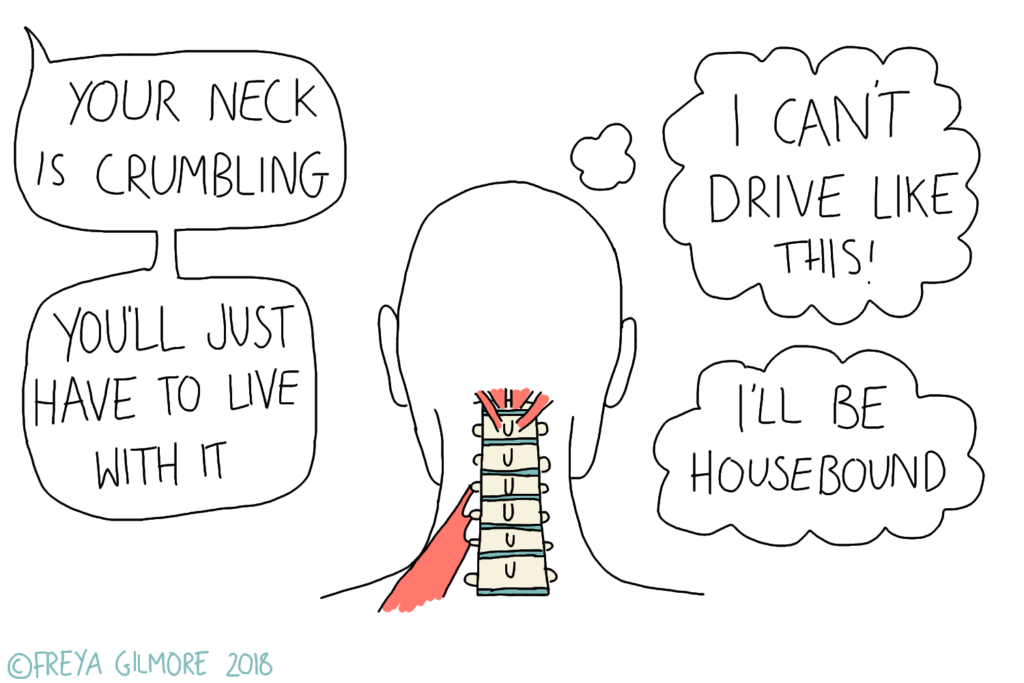
Alongside our roles as osteopaths in providing treatment and exercise, we also need to do a bit of myth-busting when patients share ideas that might actually make their pain worse. It sounds dramatic, but research shows that the way we think about our pain does affect how we experience it. For example, if you’ve been given a diagnosis of osteoporosis and the professional in charge has explained it as “your neck is crumbling”, you’re much more likely to tense up around the neck to support what you perceive to be very vulnerable. This has knock-on effects elsewhere, but also discourages you from doing exactly what the body needs: exercising it.
“Discs can pop out and need putting back in place”
The term “slipped disc” is not a useful one. Discs can bulge, where the soft inner layer pushes against the fibrous outer layer. The bulge might irritate a nerve, or it might be completely asymptomatic. Discs can also herniate, where the inner layer pushes through the outer, all still contained as a unit. But to suggest that a disc would “slip” suggests that it can become loose. In fact, a disc is so firmly connected to the bones above and below it, that if one of those bones were to fracture, the disc would stay connected and potentially limit the movement of the disconnected bone. Bulging or herniated discs reabsorb over time, and our treatment usually focuses on removing excess demand on the area to allow it to heal.
In a similar vein, discs are very deep in the back and cannot be felt from the outside. Your case history and movement will give us enough information to diagnose a disc problem without imaging. Imaging is reserved for more complex cases, and not offered routinely.
“If I have osteoporosis I should avoid doing anything that puts pressure on my bones because they are fragile”
When you are given a diagnosis of osteoporosis or osteopenia, you should also be given advice for managing it, but we know this doesn’t always happen. Bones are living tissue, and like a muscle will become bigger and stronger with exercise, the bones become more dense when they are routinely put under more demand. Of course you shouldn’t go from no exercise at all to pushing your absolute limits, but a gradual increase in load-bearing exercise is ideal for low-density bones. Your osteopath can help guide you here if you need support.
You can read our full post on osteoporosis here.
“I should only see an osteopath if I’m prepared to have my joints clicked”
Although joint manipulation (clicking) can be a useful tool, it’s not our only option. Clicking joints is a quick way to get movement, where appropriate, but often an area is too reactive to manipulate, or a patient simply doesn’t like the idea of it. We have an array of more gentle techniques for joints, which might take longer to have the desired effect but might also cause less of a reaction afterwards.
“Osteoarthritis means more and more pain until I can have a joint replacement”
Just like osteoporosis above, osteoarthritis is a condition of living tissue. In the early stages, only cartilage is affected. At this point, we can help by improving local movement to allow the cartilage more nutrients in order to heal itself. Not all cases will become less painful or restricted with treatment, but slowing down the disease process is helpful too.
There are some advanced cases where the best course of action will be surgery. You can read more about arthritis and joint replacements here.
Click here to make an appointment for your aches and pains in Devizes or Pewsey
