
You might not think “osteopath” when you have foot or ankle pain, but it’s an area we commonly see in clinic. Overuse injuries, wear and tear, and sports injuries are among the most common causes.
Plantar fasciitis
Plantar fasciitis is a common foot problem, affecting roughly 10% of adults at some point. It is a condition of irritation of the tendinous tissue on the sole of the foot. The name and some of its features (worse in the morning, good response to a cold compress) suggest inflammation. But more recent studies have shown that it is not especially inflammatory. Rolling your foot on a frozen water bottle can give some relief, both from the massage and cooling elements.
PF is often chronic, lasting for more than three months. It affects all ages and genders, with a peak around 40-60y. It is more common among people who are very athletic, and those who are overweight. We often find that the condition comes with tension in the calf muscle, and potentially dysfunction in the ankle joints.
Arthritis of the Foot
Osteoarthritis can affect any joint with cartilage, and the foot is no exception. There are many joints within the foot and they are put through their paces every day with walking, running, jumping, etc. The foot can also be quite accommodating for other areas of dysfunction: it’s not unusual to see osteoarthritis in the foot where bunions are already an issue. The good news is that arthritis is very responsive to hands on treatment, and if you can get those joints moving better affects the whole foot positively. This improves the local health within the joint, and potentially dials back your symptoms.
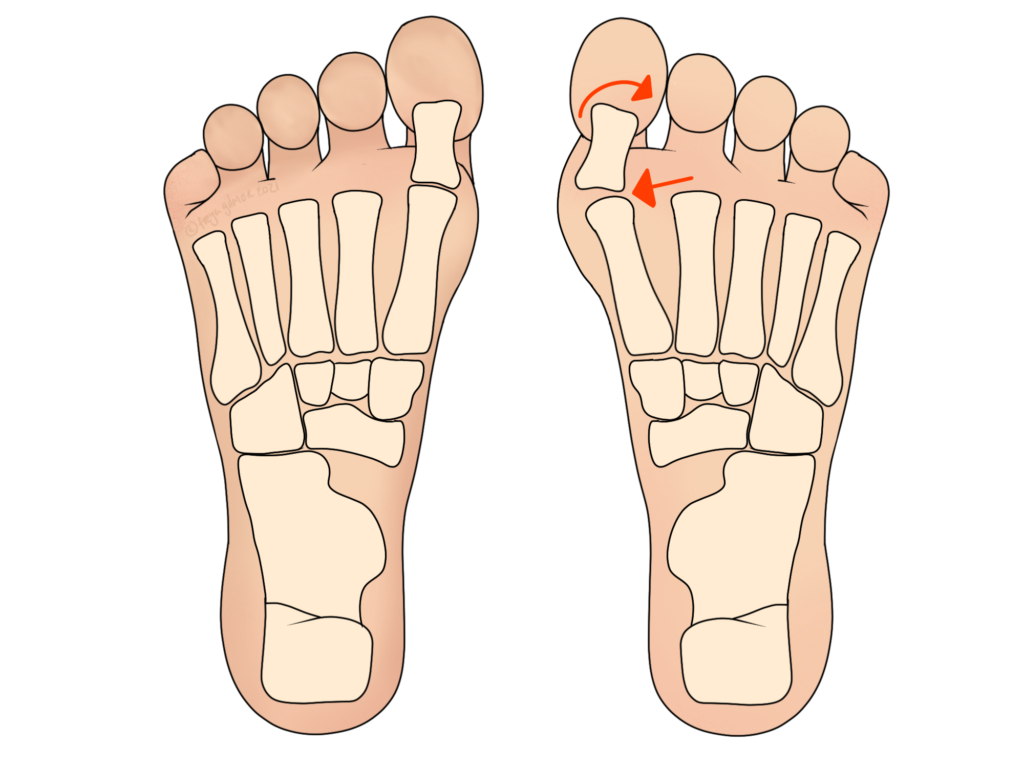
Bunions (illustrated above)
Speaking of bunions, people often think they are just cosmetic and should just be ignored. But bunions do alter the mechanics of the whole foot. The change the way you walk and potentially cause issues further up the body as well. As mentioned before, they can also encourage the development of arthritis in the foot.
Bunions are an issue in which one joint in the foot at the base of the big toe travels outwards, causing what feels like a bony lump. Severe cases may need surgery, but you may find relief through improving general foot mobility. Your osteopath can offer advice on footwear and exercises that can support your progress.
Sprained Ankles
Most ankle sprains affect the outer side of the ankle, when the sole of the foot rolls inwards. But the foot can roll the other way, spraining the inner side, or if you are wearing stabilizing footwear (like ski boots) you can sprain the tissue between the two bones in the lower leg. This is a high sprain.
When you’ve sprained your ankle once, it can predispose you to spraining it again. This is partially because the ligaments are overstretched and thus unstable, but also because of the impact this injury has on proprioception. Proprioception is the body knowing where any given part is in space, and the ligaments, that were sprained, are key to being able to do this. The good news is that rehabilitation can be really effective. Even if initiated months or years down the line.
Gout
Although uncommon, gout can be a cause of severe pain, particularly in the big toe. The primary treatment for gout is medication. If you haven’t yet been diagnosed, your osteopath can help in directing you towards this.
Osteopathy for foot and ankle problems
Your osteopath is experienced in managing and diagnosing a number of foot and ankle problems. With a combination of hands-on treatment, and advice or exercises we expect good results for the vast majority of cases.
Click here to make an appointment for your foot or ankle pain in Wiltshire
