
The tailbone (coccyx) is further down the spine than a lot of people think, and the pain can be agonising.
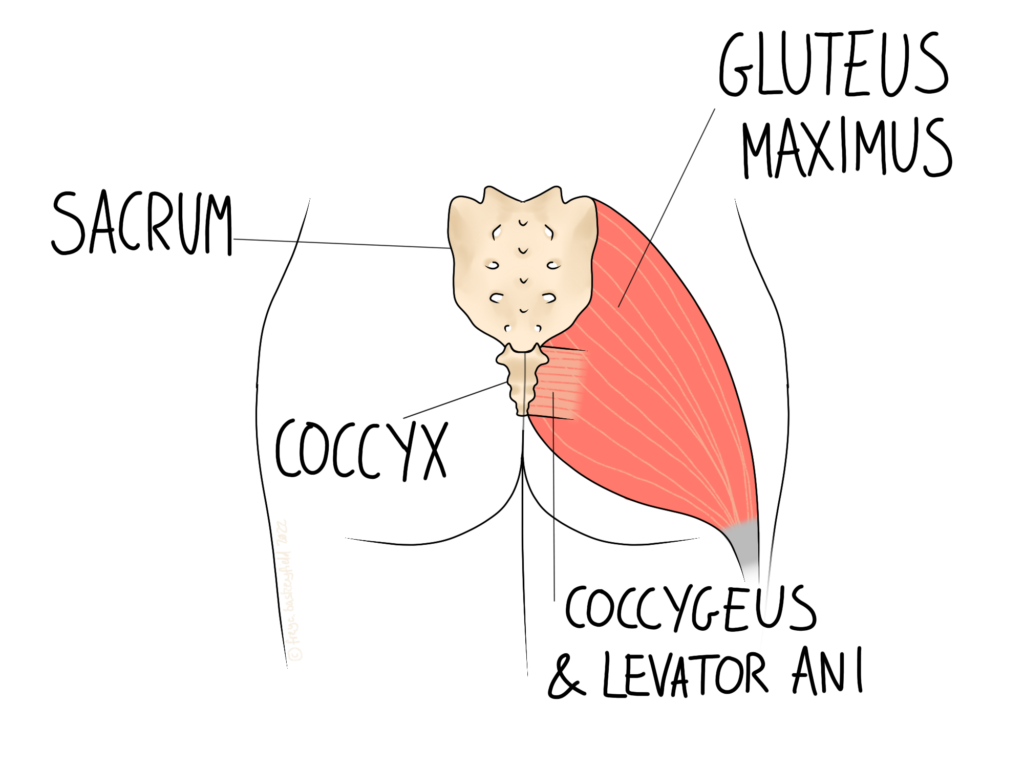
Anatomy of the Tailbone
Patients often indicate to the lower spine or sacrum when talking about their tailbone pain, but the bone itself is within the gluteal cleft. The coccyx is a much smaller bone than the others surrounding it, and it is actually made of a number of small fused bones. Its only joint is to the sacrum above it, which is a larger collection of fused bones. This makes it relatively vulnerable to injury, especially during childbirth or a fall.
Childbirth
The tailbone may be at higher risk of injury while giving birth if:
- instruments were used
- the birth was difficult or complicated
Birthing positions that put pressure on the tailbone are the same that may be recruited in the two scenarios above. It’s unclear whether the positions cause the injury or they just happen to coincide with other factors that do. They include laying on your back, reclining, or having your feet in the stirrups.
Symptoms of Coccyx Injury
Pain may be localised to the tailbone area itself,
Sitting and opening the bowels are common aggravating factors. Pelvic floor exercises may cause discomfort, but may also be an important part of your treatment plan. Moving to stand after sitting can also irritate the joint due to the forces of the muscles required.
Assessing the Tailbone
Because of the location of the tailbone, assessment is quite an intimate process. Your osteopath will likely need to you remove your trousers, so make sure you’re wearing underwear that is comfortable and offers full coverage. We may need to see how the joint moves while you’re standing and laying down, often while feeling the joint itself.
If there seems to be a link with the pelvic floor muscles, it may also be appropriate to assess these too. Your osteopath will explain this at the time, and you are not obliged to agree to any examinations you are uncomfortable with.
Management of Coccydynia
As always, the treatment plan will be directly influenced by the factors in play for your case. When there is a strong muscular element to the pain, massage and stretches for the buttock muscles may be enough to allow the joint to calm back down. Often, the muscles may be tight because of a problem elsewhere in the body, such as a change in demand for the glutes. This might be down to starting a new form of exercise, or using your body differently on a day to day basis, such as starting a job in a very different environment. Coccydynia often responds well to conservative treatment.
Some osteopaths are trained in internal techniques. These will not be performed without your written consent, and may require a chaperone in the room at the time. The benefit of these techniques is that the osteopath can directly affect the bone, but of course it is not an option that everyone is comfortable with. We can absolutely continue with a treatment plan without internal techniques.
Click here to make an appointment for your tailbone pain in Wiltshire
