
Posture is not the be all and end all, but may play an important role in your case. Everyone is different, so there’s no such thing as one perfect posture, but there are potentially bad postures that can impact you in other ways.
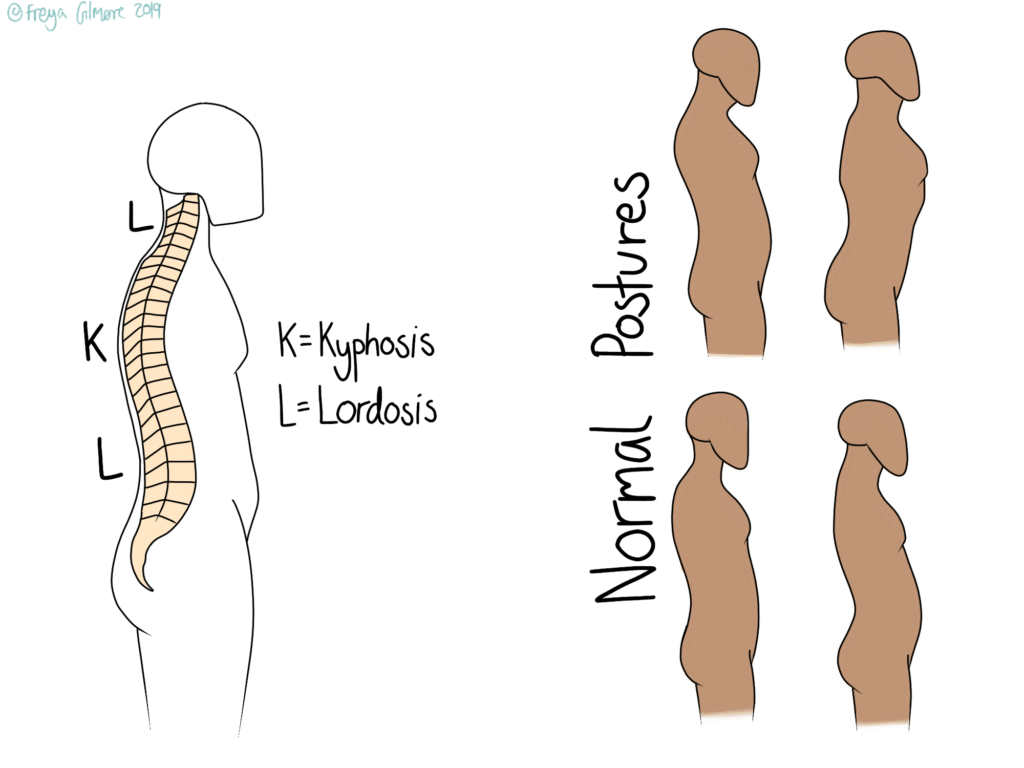
Kyphosis and Lordosis
When viewed from the side, the spine is made of three curves. The neck and lower back curve forwards, and these are lordoses. The upper back curves backwards, and that is a kyphosis. “Normal” is broad and, if you’re asymptomatic, your body has likely found a posture that works for it. However you may have had aches and pains that led to an altered posture, or perhaps over time your posture has changed and is causing problems itself. Your osteopath can work out what’s going on.
Scoliosis
If there are visible curves when the spine is viewed from the back, this would be a scoliosis. No one is perfectly symmetrical and some degree of scoliosis is normal, but again, if it causes symptoms it’s something we want to work on. Scoliosis will often come with some rotation as well as the lateral curves, which is easier to see when you bend forwards: one shoulder will appear higher than the other.
Pathological Postures
Sometimes the terms above are used interchangeably with conditions or simply used as a diagnosis. In this context, “kyphosis” generally refers to Sheuermann’s Disease. This is a condition developing in adolescence which changes the shape of the growing vertebrae. It results in a much more dramatic kyphosis than we would otherwise expect. Scheuermann’s Disease can be diagnosed on X-ray, as the vertebrae take on a bamboo like appearance.
Scoliosis can also be considered pathological if it causes problems. Generally a scoliosis will develop in adolescence and is measured with a “cob angle”. This is a simple calculation based on two points of the curves. It’s a helpful tool that provides thresholds for the most appropriate treatment plan. A mild scoliosis might just warrant physical therapy, whereas more severe cases would warrant a back brace or even surgery.
Why Your Posture Might Change Over Time
Significant changes to demands on the body, such as in pregnancy, can lead to postural changes that may become permanent over time. Using pregnancy as an example, a newly postpartum mother will likely have a degree of a sway back posture. This is a hangover from a combination of changing center of gravity due to the growing bump and ligamentous changes due to hormones. After months of adapting to this role, it takes a while (and sometimes hard work) to restore muscular balance and posture. Breastfeeding can also encourage changes in posture due to holding (often kyohotic) positions for long periods of time.
Another common change in posture is potentially associated with osteoarthritis of the hip. As the hip loses extension (a typical first sign of arthritis) the body compensates to avoid losing stride length by tilting the pelvis and contributing to an “elderly posture”. Here the lower back flattens the upper back rounds and the next compensates to raise the head. The body is a great compensator, and it’s possible that you could develop that posture without even realising you have hip arthritis.
Osteopathy for Your Posture
Your osteopath’s role with regards to posture is twofold. Firstly to identify what is truly problematic, and secondly to correct it. You may have an unusual posture but if it doesn’t cause any problems it might be best to just leave it alone. However if your posture is associated with pain, we can work out what has changed and what can be done for it.
Click here to make an appointment in Devizes or Pewsey for your posture.
